I've been in safety since 2007, and before that I was in oil and gas, working as a valve mechanic, laborer, and doing hole watch and fire watch. So when people ask me about OSHA's heat rule, I don't start with the Federal Register. I start with the guys out there sweating through their shirts by 9 a.m.
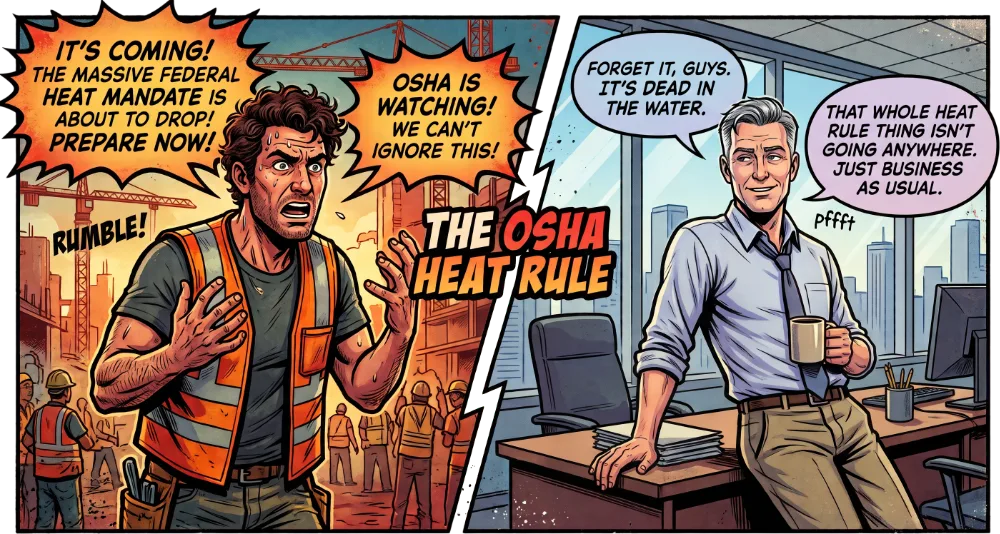
Right now I'm hearing two stories. One says a big federal heat mandate is about to drop on everybody. The other says it's dead and you can forget about it. Neither one is right, and if you're running a safety program, you need the real picture because ignoring it is the wrong idea.
Here's where it stands
On August 30, 2024, OSHA published a proposed rule called Heat Injury and Illness Prevention in Outdoor and Indoor Work Settings. It would be the first federal heat standard OSHA has ever had. The basic idea is that at an 80°F heat index, you'd need cool water (a quart per person per hour), shade or a cool area, a first-week acclimatization plan, and paid rest breaks as needed, and at 90°F you'd add mandatory paid breaks of at least 15 minutes every two hours, somebody watching your people for symptoms, and a hazard alert.
Then it stalled. OSHA held hearings from June 16 through July 2, 2025, and closed the last comment window on October 30, 2025. Nothing final since. Now OSHA plans to put out a supplemental proposal that reworks the original, and at the National Safety Council's Safety Congress this month, Andrew Levinson, who runs OSHA's Directorate of Standards and Guidance, said it could come out soon. His words were that the agency "did a proposed rule and now we have different thoughts." There'll be another round of public comments, and OSHA's own agenda puts the supplemental proposal in December 2026 and a final rule in October 2027. We'll see. Dates like that have a way of sliding.
But here's the part a lot of folks miss: enforcement didn't stop. OSHA revised its heat National Emphasis Program on April 10, 2026, and it's good for five years (CPL 03-00-024). It targets 55 industries, and inspectors will do random inspections on days the National Weather Service puts out a heat advisory or warning. And this is not theoretical. By OSHA's own count in that directive, federal OSHA averaged about 2,400 heat-related inspections a year from 2022 through 2025, and roughly 50 of those each year were fatality inspections. So no rule doesn't mean nobody's watching.
Why some people want a hard rule
I get this side. Extreme heat is the leading cause of weather-related deaths (that is OSHA's own line in the proposal, not mine), and heat illness is about as preventable as it gets. Water, shade, rest, and easing new guys into the heat are not rocket science and they're not expensive.
The other argument is fairness. Without a standard, OSHA writes heat citations under the General Duty Clause, which basically says keep your workplace free of recognized serious hazards. It doesn't tell you exactly what "good enough" looks like. A clear rule would put everybody on the same playing field, so the contractor who takes care of his crew isn't getting underbid by the one who doesn't. And seven states already have heat protections on the books, so why should a worker in one state get less protection than a worker in another?
Why some people want it scaled back
I get this side too. The pushback isn't "heat's not dangerous." It's about how the rule was written. The Coalition for Workplace Safety, joined by 81 other employer organizations, told OSHA the proposal is "inflexible" and "one-size-fits-all," and asked the agency to pull it back and rewrite it so employers can tailor a heat program to their own work environments.
Think about it from the field. One heat index trigger is supposed to work for a roofer, a farmhand, a line cook, and a guy in a warehouse. A rest schedule that makes sense for somebody carrying bundles of shingles up a ladder might be overkill for somebody working in the shade. And small outfits worry about paperwork that doesn't make anybody safer. Critics would rather set the goal and let the people who know their jobsite decide how to get there.
What I'd tell you to do right now
Whichever side you land on, don't sit around waiting for Washington. Summer's winding down, and that's exactly when this slides off the radar. The time to build the plan is the cool months, not the first 95-degree day next year when somebody's already down.
Inspectors are out there now, and you can get cited even without a specific standard written into OSHA's books. On hot days, inspectors are paying closer attention, and when they look at your heat program, they're working from a checklist in the enforcement program. It's Appendix I of the NEP, eleven questions covering water, rest breaks, shade, acclimatization, training, and who's named to run the program. I've put the whole list at the bottom of this piece. That overlaps with the proposed rule, but the rule's specific requirements, like mandatory breaks at 90°F, aren't law yet. And whatever the final rule looks like, if it ever shows up, the basics aren't going to change. You still need a written plan, water and shade, rest breaks, a way to acclimate new and returning workers, training so your people know the signs, and a plan for when somebody goes down.
Get those in place now and you win either way. Your crew is safer, you're in better shape if an inspector shows up, and you're not scrambling if a rule lands in 2027. If it never lands, you've still got fewer people getting sick and fewer lost days.
The folks in DC can keep arguing about the details. There are good points on both sides. But the heat on your jobsite doesn't care about rulemaking, and your plan shouldn't either.
If you need help documenting a heat plan and training your crew to handle it, give us a call and I'll get someone out to your site.
The eleven questions an inspector works from
Straight out of Appendix I of the heat NEP, the evaluation a compliance officer runs against your heat program. Read it before somebody reads it to you.
- Is there a heat program, written or verbal, that is effectively communicated to employees?
- How did the employer monitor ambient temperatures and levels of work exertion at the worksite?
- Were there sufficient amounts of cool water easily accessible to employees?
- Did the employer allow additional breaks for hydration?
- Were there scheduled rest breaks?
- Was there access to a shaded area?
- Did the employer provide time for acclimatization of new and returning workers?
- Were administrative controls used (earlier start times, workload adjustments, employee and job rotation) to limit heat exposure?
- Did the employer provide training on heat illness signs, how to report symptoms, first aid, how to contact emergency personnel, prevention, and the importance of hydration?
- Do employees and supervisors understand the heat program?
- Is the heat program properly implemented and managed by a designated heat safety representative?